
Why Tributary Is Raising on Futarchy
Most on-chain payments are optimized for the first transaction. The second one – and the 200th – is where products either become reliable infrastructure or quietly break.
Crypto is pretty good at one-off transfers. It is still weirdly bad at recurring payments. Subscriptions, repayments, usage-based billing, scheduled payouts, milestone-based compensation, agent-controlled spending. These are the flows that decide whether a product becomes an operation or stays an experiment.
That gap is why we built Tributary. Recurring payment infrastructure for Solana.
What Tributary Is
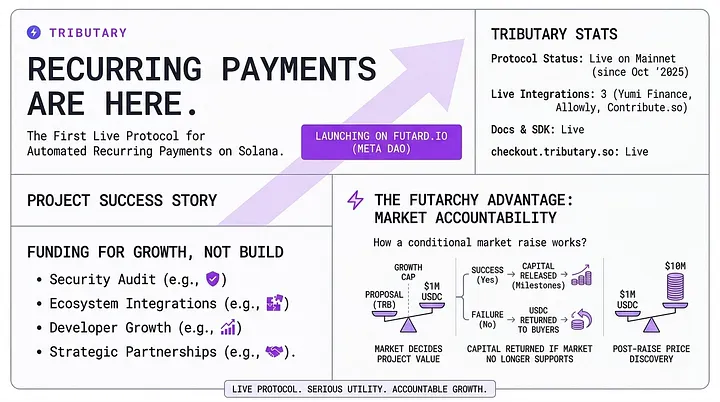
Tributary is a live protocol on Solana mainnet. It handles recurring payment logic: subscriptions, milestone payments, pay-as-you-go billing, and (soon) controlled top-ups. Developers integrate a reusable payment layer instead of building custom rails from scratch every time.
The approach is non-custodial. Users authorize payment policies with explicit constraints: who gets paid, how much, when, and when it stops. Payments execute according to those rules. Users can pause, resume, or cancel anytime.
The protocol charges a 1% fee on payment volume. That fee flows into a treasury soon to be owned by token holders. More payment volume, more fees, more treasury value. Simple.
What’s Already Live
Tributary has been live on Solana mainnet since October 2025. This isn’t a whitepaper or a roadmap promise.
- The app: app.tributary.so
- The docs: docs.tributary.so
- The SDK:
@tributary-so/sdkon npm - The checkout: checkout.tributary.so
Yumi Finance is already using Tributary in production for cash loans with automatic repayments. That’s a serious use case. Repayments aren’t a marketing moment. They’re a reliability test. They’re the part of a product that has to work even when nobody is watching.
Allowly runs recurring subscription flows on Tributary. Contribute.so runs recurring crypto donations for GitHub developers. Each hits a different surface area of the same underlying problem: money that needs to move repeatedly, predictably, and with clean UX.
Why the Category Matters
When most people hear “recurring payments,” they think “subscriptions.” That’s part of it. The category is broader.
- SaaS billing – monthly software licenses, API access
- Lending – automated repayments on fixed schedules
- Commerce – repeat merchant flows, checkout integrations
- Creator economy – memberships, recurring support, patronage
- Professional services – retainers, milestone-based project payments
- AI and agents – usage-based billing, controlled top-ups, spending limits
Money that needs to move repeatedly, according to rules, without rebuilding the whole system every time.
If Solana is going to support real software businesses, real commerce, and real on-chain organizations, recurring payments can’t remain a bespoke workaround that every team reinvents alone.
Why Raise on Futarchy
We’re raising via MetaDAO’s Futard.io. The choice is intentional, not convenient.
In a traditional raise, valuation is negotiated in a small room. Narrative does a lot of work. Everyone’s incentives are to sound confident, simplify risk, and move fast.
Futarchy flips the posture.
It’s harder to hide behind a deck. It’s next to impossible to outsource diligence to “smart money.” It rewards clarity, not charisma. It makes it obvious whether the market thinks the product is real enough to underwrite today.
For payments infrastructure specifically, this alignment matters. Payments isn’t a meme category. It’s the part of the stack where people care about reliability, edge cases, and whether integrations will keep working next month.
The MetaDAO community has seen what happens with hype-first raises. Ranger raised $8M on trading infrastructure promises and was liquidated by governance vote.
The community has also seen what succeeds. Omnipair raised $1.1M with working code and is up 100% from ICO. Umbra raised $3M with a working privacy protocol and is up 39% from ICO.
Real product, specific use case, conservative target. That’s the pattern Tributary fits.
The question the market needs to answer isn’t “will this product work?” It already works. The question is “will it grow?” Futarchy lets participants answer that question with real capital and real consequences. If the market says yes, the raise proceeds fund growth. If it says no, everyone gets their capital back.
The primary reasons we chose Futard.io, in order of priority:
- It lets you raise from a wide audience without backdoor deals.
- It lets you hand over the contract to the DAO.
- It gets you attention about the product you build.
What the Raise Funds
The product is built. This isn’t about proving Tributary can exist. It already does.
The capital funds the next stage:
- Audit – security and trust matter for infrastructure people build on
- Runway – roughly six months to execute without distraction
- Integrations – more live products running on Tributary
- Growth – developer onboarding, ecosystem awareness, clearer use-case packaging
The risk investors are underwriting isn’t execution risk. It’s growth risk. That’s a fundamentally different bet. Arguably a smaller one.
Who’s Building This
Dr.-Ing. Fabian Schuh. 10+ years in web3. Work across multiple top-10 L1 ecosystems. Full-time on Solana for two years. Superteam Germany member. PhD in engineering.
Fabian has built on BitShares, Steemit, and Hive. In the last two years he has worked on multiple projects (most of them stealth) on Solana. He also built web2 products that integrated with payment providers such as Adyen and Stripe – for instance relay.md. This gives him direct experience with the kind of product and crypto payment problems Tributary solves.
He also built repo.trade, which clarified the need for simpler recurring support flows. repo.trade became contribute.so.
This isn’t a team chasing a narrative. It’s a protocol founder with real shipping history building infrastructure for an important category.
AMA
Fabian will attend ownershipfm radio on Sunday 19th April 2026 to answer all your questions.
The Honest Framing
Tributary is early in adoption. PMF is not proven. We haven’t done a serious growth push yet.
But early is different from imaginary. The product is live. The SDK exists. The docs exist. Multiple payment models exist. And there’s already live usage.
Important category. Live product. Real integrations. Clear room to scale. Raising through a mechanism that holds us accountable from day one.
If that’s the kind of bet you want to evaluate:
- Tributary
- App: app.tributary.so
- Docs: docs.tributary.so
- SDK:
npm install @tributary-so/sdk - Checkout: checkout.tributary.so
- Telegram: t.me/tributaryso
Read the docs. Touch the app. Look at the integrations. Ask hard questions.
That’s the standard we’re building to.
Room for Innovations
Recurring payments on-chain are still early. What’s left to build:
- Trustless fee distribution where token holders vote on treasury allocation
- Cross-chain recurring payments using the same policy model
- Agent-native payment policies where AI models manage their own spending limits without human intervention
Tributary is live. The raise is live on Futard.io. If the market thinks this category matters, the capital arrives. If not, we keep shipping anyway.